

How Farmers Can Reduce Chemical Dependency Using Modern Agricultural Solutions
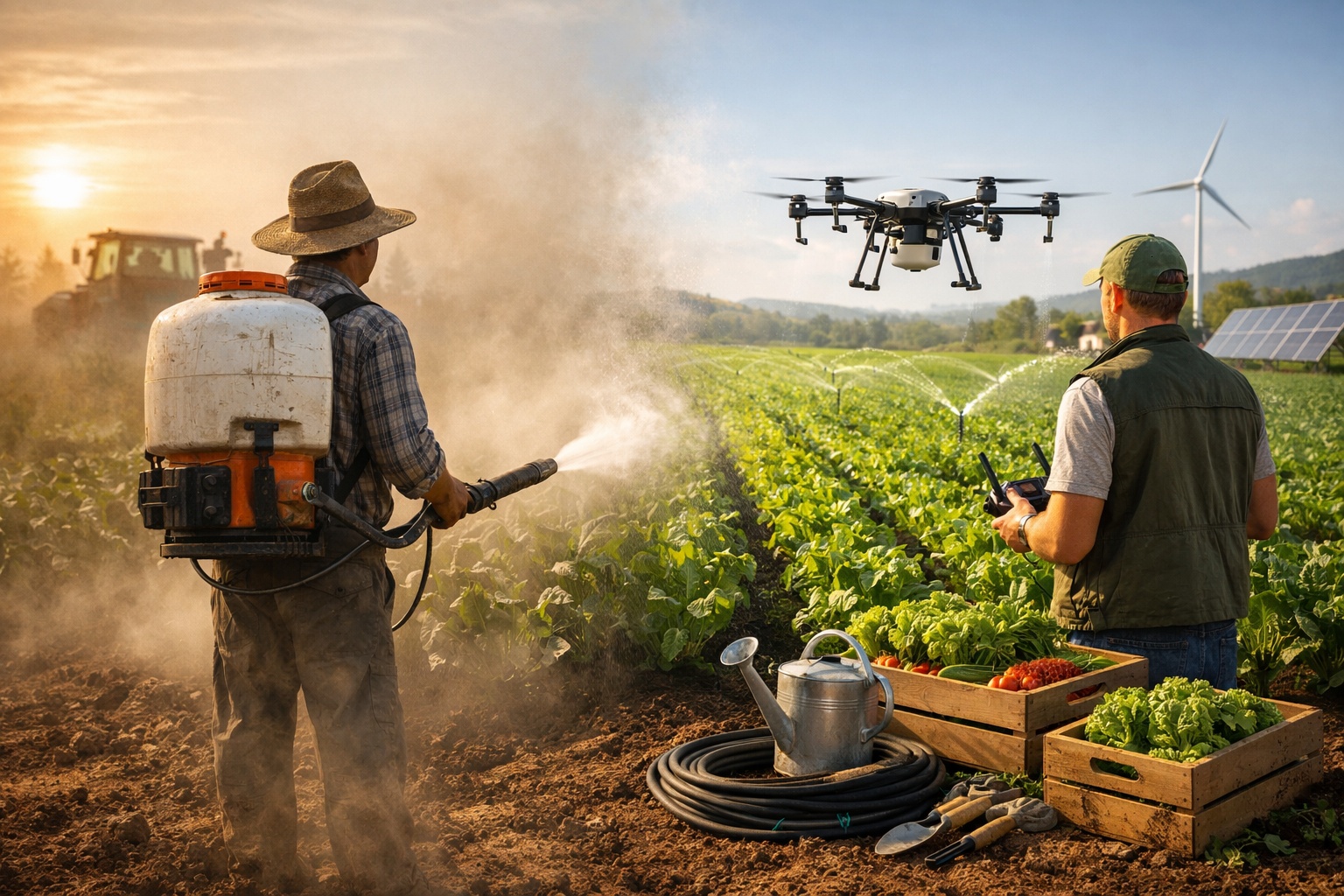
Why Is Chemical Dependency a Growing Concern in Agriculture?
Modern agriculture has helped farmers significantly increase crop yields and meet growing global food demand. However, excessive dependence on synthetic fertilizers and pesticides is creating long-term challenges for farming systems. Soil degradation, pest resistance, rising input costs, and environmental concerns are pushing the agriculture sector toward more sustainable and data-driven farming practices.
Chemical dependency puts the production risk to the level making it a source of the degradation of natural resources. FAO estimates that roughly 33% of the world’s soils have shown signs of degradation at a level from moderate to severe. EPA monitoring links agricultural runoff to nitrate contamination in rivers and groundwater. Excessive usage of synthetic fertilizers and pesticides leads to a faster loss of soil biodiversity and a decrease of agroecosystem stability.
Today, farmers can reduce chemical dependency without compromising productivity by adopting smarter farming approaches such as Integrated Pest Management (IPM), precision agriculture technologies, biological crop inputs, and improved soil health management practices.
Key drivers behind chemical dependency include:
- Overapply synthetic fertilizers to push short-term yield gains.
- Continue spraying pesticides without monitoring pest thresholds.
- Reduce crop rotation, disrupting the balance of the agroecosystem.
In the next section, you will notice how Integrated Pest Management gives a framework to decrease pesticide use while maintaining yield.
Why Is Chemical Dependency a Growing Concern in Agriculture?
Chemical dependency in agriculture has become a serious issue because of its long-term impact on soil quality, crop resilience, and environmental sustainability.
According to the Food and Agriculture Organization (FAO), nearly 33% of the world’s soils are moderately to highly degraded due to unsustainable farming practices. One of the key drivers of this degradation is the excessive and repeated application of synthetic fertilizers and pesticides.
Although chemical fertilizers can promote rapid plant growth, overapplication gradually reduces important soil characteristics such as:
- Soil organic matter
- Beneficial microbial activity
- Nutrient cycling efficiency
- Soil water retention capacity
When soil microbial diversity declines, nutrient availability becomes less efficient. Farmers then apply higher quantities of fertilizers to maintain yields, which further accelerates soil degradation.
Excessive pesticide use also contributes to pest resistance. Over time, insect populations genetically adapt to chemical treatments, forcing farmers to either increase pesticide dosages or switch to stronger chemicals. This creates a cycle of rising costs and decreasing long-term farm resilience.
In India, many farmers are already experiencing several consequences of excessive chemical use, including:
- Secondary pest outbreaks
- Declining soil fertility
- Increasing fertilizer requirements each season
- Higher crop protection costs
Environmental monitoring programs have also linked agricultural runoff to nitrate contamination in rivers and groundwater, posing risks to ecosystems and water resources.
At the same time, governments, export markets, and food retailers are encouraging farmers to reduce chemical residues and adopt more responsible production systems.
How Does Integrated Pest Management (IPM) Reduce Pesticide Dependency?
Integrated Pest Management (IPM) is a science-based approach that reduces pesticide dependency by combining biological, cultural, mechanical, and chemical control methods.
Instead of spraying pesticides on a fixed calendar schedule, IPM focuses on monitoring pest populations and applying control measures only when pest levels exceed economic threshold limits.
Crop Scouting and Monitoring
IPM begins with regular crop scouting to monitor pest populations and detect early signs of infestation.
Farmers inspect different parts of the crop, including:
- Leaves
- Stems
- Soil surface
- Underside of foliage
Pest numbers are recorded and compared with economic injury levels, which indicate when intervention becomes economically justified. If pest density remains below the threshold, chemical spraying can be avoided.
Regular monitoring alone can significantly reduce pesticide use because many pest populations never reach damaging levels.
Biological Pest Control
Another important component of IPM is biological control, which uses natural predators and microorganisms to manage pests.
Examples include:
- Lady beetles feeding on aphids
- Trichogramma wasps controlling caterpillar eggs
- Bacillus thuringiensis (Bt) targeting larval pests
- Neem-based bio-pesticides controlling sucking insects
These biological solutions maintain ecological balance while reducing reliance on synthetic pesticides.
Crop Rotation
Crop rotation is also an effective strategy for reducing pest pressure. Growing the same crop repeatedly allows pests to build up in the soil, while rotating crops disrupts pest life cycles.
Examples include:
- Maize followed by soybean
- Wheat followed by pulses
- Rice followed by vegetables
Crop rotation not only reduces pest populations but also improves soil nutrient balance and fertility.
By combining pest monitoring, biological control agents, and crop rotation practices, IPM shifts pest management from reactive spraying to preventive ecosystem management.
How Can Precision Agriculture Reduce Fertilizer and Chemical Waste?
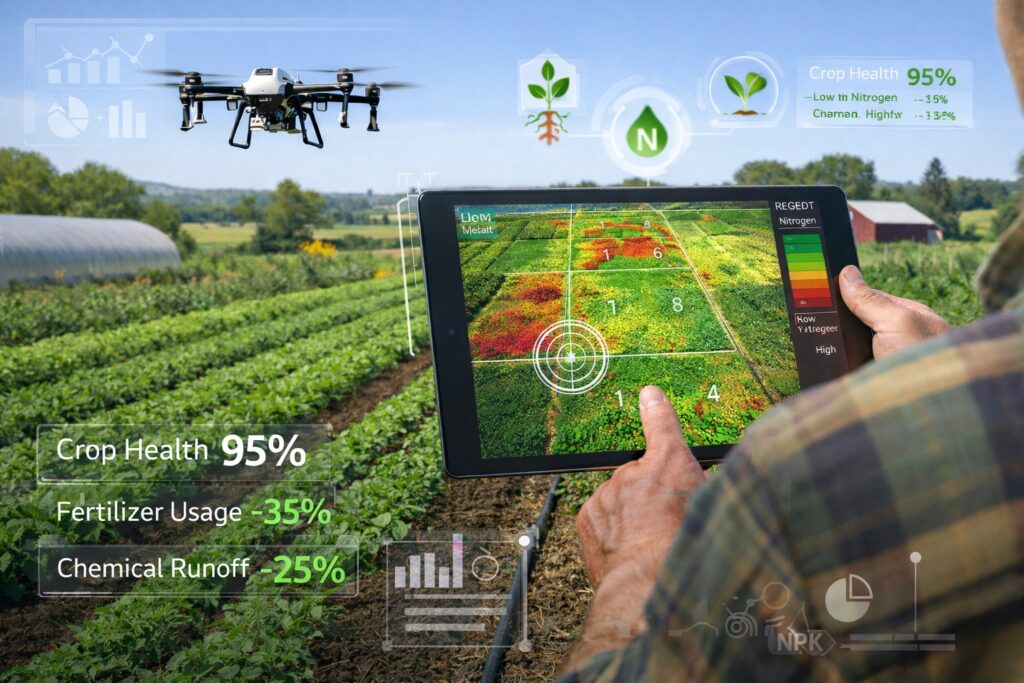
By tailoring fertilizer usage to the needs of specific areas, precision agriculture drastically reduces the wastage of fertilizers. Smart farming devices assist in determining the variability of soil nutrients, moisture, and crop health.
GPS and guided sprayers improve application accuracy and thereby eliminate the problem of double spraying. Variable rate technology is capable of changing the quantity of fertilizer being spread depending on the soil test results. For example, one patch of the field may receive 220 kg of nitrogen, while the other only 150 kg/ha. Non-uniform application results in more waste and chemical runoff.
Drones and satellite images (remote sensing) assist in plant health monitoring and in detecting the initial signs of plant stress. AI crop analytics platforms evaluate the vegetation indices and predict the likelihood of diseases. Then, farmers can apply spot treatments rather than spraying the entire field.
Soil moisture detection by IoT sensors can significantly enhance water use efficiency. From the University extension programs, it is known that precision systems have the potential to decrease fertilizer use by 15% to 20% without lowering the quality.
Precision agriculture mainly relies on the following methods to produce results:
- Apply a variable rate application based on soil mapping data.
- Use remote sensing to detect localized crop stress.
- Reduce overlap through GPS-guided spray systems.
Precision agriculture is focused on replacing guesswork with quantifiable decisions. There is a direct reduction in chemical runoff as a result of less overlapping, spraying only the targeted areas, and zone-based fertilization. The following part shows how regenerative farming aids the soil systems in a natural way.
How Does Regenerative Agriculture Improve Soil Health and Reduce Inputs?
Regenerative farming achieves chemical reduction in the first place through restoring soil organic matter and enhancing nutrient cycling. First, balanced soil behaves as a biological system in fact rather than just a growth medium.
Cover crops help protect the soil against degradation during the fallow period between two main crops. Leguminous plants, such as clover, which, by means of their association with Rhizobium bacteria, can fix nitrogen from the air. Thus, natural nitrogen fixation significantly lowers the requirement for synthetic nitrogen fertilizers for the following crop.
No, till agriculture helps keep soil aggregates intact and decreases soil erosion. According to data from NRCS, conservation tillage is effective in lowering soil erosion rates as compared to traditional plowing. The higher the level of soil organic matter, the better the water retention ability. Plants cultivated in soils rich in organic matter are able to withstand drought stress better. Applying compost not only inoculates soil with beneficial microbes but also helps in the gradual release of nutrients.
Experiments done at the Rodale Institute have shown that regenerative farming practices lead to an increase in soil carbon stocks over time. A rise in microbial activity results in better nutrient availability and lower nutrient losses.
Regenerative systems reduce chemical use through:
- Increase soil organic matter to improve nutrient retention.
Strengthen microbial activity to enhance nutrient cycling. - Diversify crop rotations to reduce pest pressure.
When soil biological activity increases, fertilizer efficiency rises naturally. In the next section, you will explore biological inputs that directly replace synthetic nutrients.
How Do Biofertilizers and Biological Inputs Reduce Chemical Fertilizer Use?
Biofertilizers are one of the most effective nature-based solutions for reducing dependence on chemical fertilizers in agriculture. Instead of supplying nutrients directly like synthetic fertilizers, they introduce beneficial microorganisms into the soil. These microbes improve nutrient availability, enhance soil biology, and help plants absorb nutrients more efficiently.
One of the most important biological processes in agriculture is nitrogen fixation.
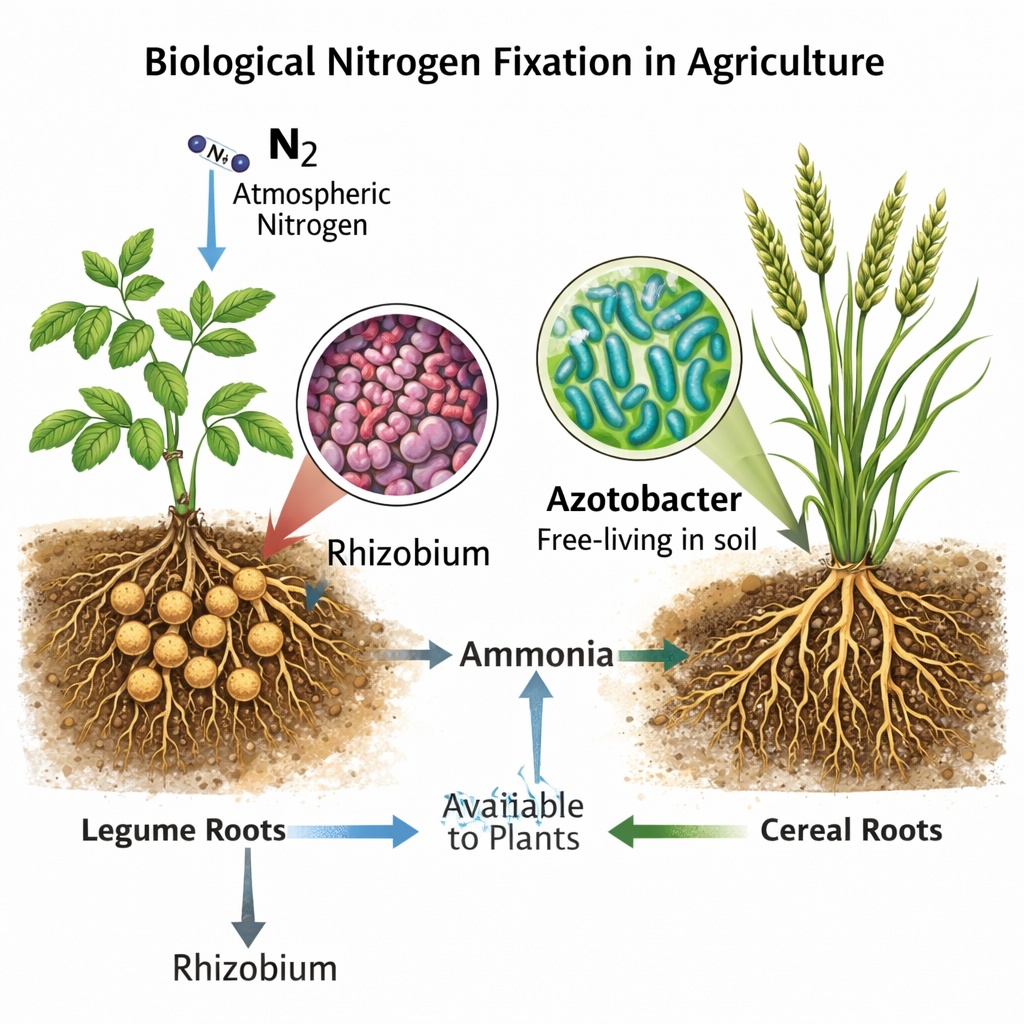
- Nitrogen fixation by Rhizobium in legume root nodules and Azotobacter in soil helps convert atmospheric nitrogen into plant-available forms.
Rhizobium bacteria live inside the roots of legumes in a mutually beneficial partnership and extract nitrogen gas from the air to convert it into ammonia, which is a source of nitrogen for the plant. Azotobacter, being a free, living nitrogen-fixing bacterium, is thus considered to play a supplementary role in nitrogen fixation in cereal crops. Mycorrhizal fungi support the plant mostly through their hyphae which serve as the root system extensions of the host plant, thus significantly increasing the absorbing surface and making phosphorus solubilization more efficient by releasing more areas for colonization.
Moreover, these microbes release phytohormones which help plants grow. Through the formation of more extensive root systems, plants absorb nutrients more efficiently. What is even more fascinating is that many farmers who have used such microbial inoculants report that they could clearly see the onset of early growth and an increase in root volume.
One excellent example of organic fertilizers is composted manure, they are a good source of slowly releasing organic nutrients. The fundamental distinction between them is that biological inputs in the soil supply nutrients slowly, whereas synthetic fertilizers give a fast nutrient release. On top of that, the biological mechanism that allows nutrient release from organic matter happens at a slow pace, and therefore, less leaching takes place, which ultimately leads to stable crop growth.
Biological inputs function through:
- Fix atmospheric nitrogen through microbial symbiosis.
- Enhance phosphorus uptake via mycorrhizal associations.
- Stimulate root growth using natural growth hormones.
Organic standards highlight biological soil management as one of the methods for reducing the dependence on chemical fertilizers. The following section will discuss how policy frameworks provide financial support for these changes.
How Do Government Programs and Certifications Support Chemical Reduction?
Government subsidies reduce the financial risks of changing farm ownership. A USDA Organic certification is a ticket for farmers to the premium markets. Organic products usually get higher prices in the market, thus farmers get compensated for the lower input intensity during the transition period.
NRCS conservation grants provide farmers with cover crop and soil health practices. The Farm Bill has climate-friendly agriculture programs that mainly focus on carbon sequestration and sustainable crop systems. In Europe, the European Green Deal is a law with clear targets for pesticide usage reduction.
Farmers can be paid carbon credits for the increase in soil carbon stock. Eco-labeling schemes contribute to establishing traceability and transparency, which strengthens a farmer’s position in both local and online agriculture marketplace networks.
Support mechanisms often include:
- Provide farm grants for conservation practices.
- Reward carbon sequestration through carbon credit schemes.
- Enable premium pricing through organic certification.
In cases like this, farmers can make the entire situation financially viable if they add the economic incentives of improved management systems. At the end, you’ll find a neatly structured stepwise guide for hands-on implementation at your farm.
What Is a Practical Step-by-Step Plan to Reduce Chemical Use?
Effective reduction of farm chemical use needs a gradual change. An abrupt stop can result in a higher risk of production. The phasing-out method keeps the yields stable.
Start by checking the soil with a soil test. Nutrients’ profile of the soil will tell you what element is missing in the soil and thus you will be free from too much application of fertilizers. If you consult with agronomists or extension services, you will get more detailed explanations of the results.
Only a small part of your farm should be demonstration plots. These plots can be used for regenerative farming, biological pest control, or decreased fertilizer rate treatments. The production and pest situation of the plots should be observed and documented carefully.
Reduce your synthetic inputs by approximately 10% to 20% each season. A yearly cost-benefit analysis should be done. Look at input cost savings, soil organic matter percentage, pest incidence, and yield consistency. Farming cooperatives facilitate the sharing of field data and thus reduce the risk of transition.
Farm Chemical Reduction Roadmap
| Step | Action | Measurement Indicator | Expected Outcome |
| 1 | Conduct soil testing | Soil nutrient profile, pH, and organic matter | Accurate fertilizer planning |
| 2 | Consult agronomist | Nutrient recommendation report | Reduced over-application |
| 3 | Establish pilot plots (5–10%) | Yield data, pest counts | Risk-controlled experimentation |
| 4 | Reduce inputs by 10–20% per season | Fertilizer and pesticide volume records | Gradual dependency decline |
| 5 | Perform annual cost-benefit analysis | Input cost vs. yield revenue | Financial sustainability check |
| 6 | Monitor soil health annually | Soil organic matter %, microbial activity | Improved long-term fertility |
| 7 | Join cooperative networks | Shared performance benchmarks | Lower learning cost and risk |
This well-thought-out plan takes the data of the soil, field trials, financial analysis, and cooperative learning, and combines them into one integrated strategy. Each step not only deepens decision-making but also eliminates the use of chemicals while maintaining the farm production level.
An effective transition plan should:
- Test soil annually and adjust nutrient plans accordingly.
- Implement pilot plots before full-scale adoption.
- Track yield stability and input cost reduction each season.
This shift toward sustainable agriculture is essentially a coming together of IPM, precision technology, regenerative practices, biological inputs, and policy support. At the same time, these five components work soil health and the overall stability of the agroecosystem; they also naturally lead to a decrease in chemical use, and they continue to ensure farm profitability over time.
Frequently Asked Questions (FAQs)
1. How long does it take to reduce chemical dependency safely?
Typically, a farm requires 2, 3 growing seasons before a significant change can be recorded. A slow decrease in input by 10, 20% each season keeps the yield stable. The advancement of soil organic matter is usually noticeable when the practice of using cover crops and less tillage becomes consistent.
2. Will yields drop if I reduce fertilizers and pesticides?
Yield fluctuation during transition may be temporary. Studies of regenerative trials reveal that as soil organic matter goes up, the stability of yields increases. Careful nutrient management and IPM threshold monitoring help in avoiding significant production losses.
3. Is Integrated Pest Management expensive to implement?
IPM reduces the overall costs in the long run. Hiring a scout to monitor and counsel does not require a big capital, just the time invested. Usually, the money saved from buying less pesticides and doing fewer crop sprays will cover the cost of monitoring labor by the end of the second season.
4. Can biofertilizers fully replace synthetic fertilizers?
Biofertilizers don’t often replace 100% of synthetic fertilizers at once. They cut the dependence slowly by enhancing nitrogen fixation and phosphorus uptake. Lots of farmers mix biological inputs with lowered synthetic rates while they are in transition.
5. What is the first step if I want to start this transition?
The first thing to do is to carry out soil testing and gather field data. Precisely determined soil nutrient profiles are the mainstay to cut down on fertilizers. In the absence of baseline data, the chemical reduction will turn into guesswork and the production risk will rise.